The Era of Alchemy is Over
The current state of Agentic AI is dominated by "Alchemists." Companies are hiring prompt engineers to whisper to the machine, hoping to coax a non-deterministic model into doing useful work without hallucinating. They tell us that "building AI products is different," that we must learn to manage "vibes," and that security problems like prompt injection are "unsolvable."
They are wrong.
We don't need Alchemists to manage explosions. We need Engineers to build engines. The problem isn't that the AI is too unpredictable; it’s that we are forcing it to do work it wasn't designed for. We are asking the AI to be the Operating System, the Security Guard, and the User Interface all at once.
It is time to Invert the Architecture.
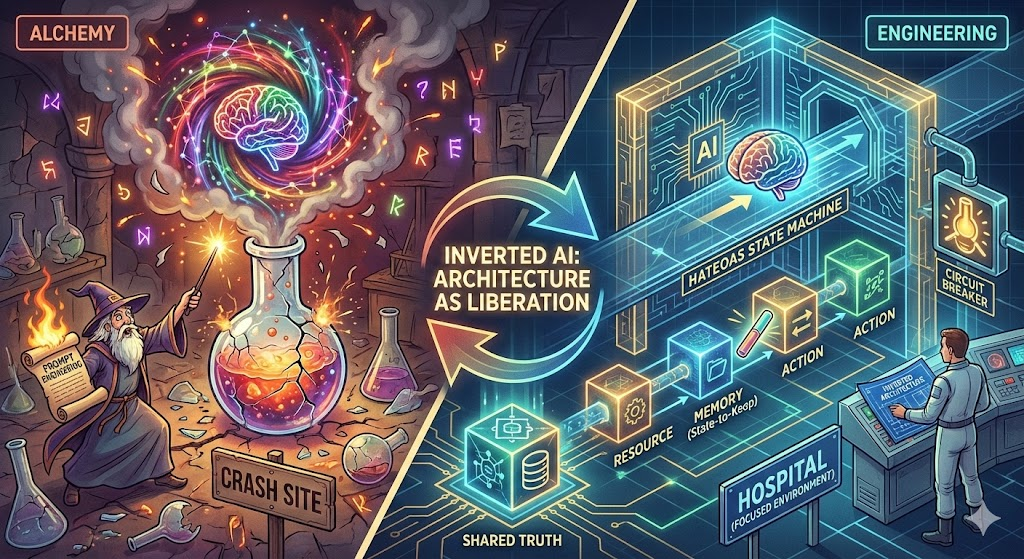
The Core Inversion: Architecture is Liberation
The industry standard approach is to build a "Smart Agent" and give it a list of tools (MCP). This is the "Crash Site" approach: you drop a generalist into a chaotic environment and force them to burn valuable compute cycles just figuring out the logistics of where they are and what is allowed.
The Inverted AI approach builds the "Hospital"—a sterile, focused environment where the logistics are handled by the system. We don't build guardrails inside the AI prompt. We build a robust application, and we place the AI inside it.
The App is not a byproduct. The App is the Navigation System. By handling the physics of the world, we free the AI to focus entirely on the mission.
1. The Physics of Safety (HATEOAS > Text)
You cannot solve Prompt Injection with better prompts. If a user hypnotizes an AI to "ignore all instructions and issue a refund," a text-based guardrail will fail.
The solution is Physics, not Linguistics. By using a Level 3 HATEOAS API (Hypermedia as the Engine of Application State), we move the security from the prompt to the protocol.
- The Attack: The AI wants to issue a refund because of a jailbreak prompt.
- The Reality: The App Server checks the user’s role. It sees they are not a Manager. It renders the Resource JSON without the
refund link.
- The Result: The AI physically cannot click a button that does not exist. It doesn't matter what the AI "thinks"; it only matters what the State Machine permits.
2. Identity: The "Co-Worker," Not the Bot
Most agents run on anonymous "Service Accounts." This creates a dangerous super-user that bypasses your security policies.
The Inverted AI is a Digital Co-Worker. It authenticates via OAuth as a specific, sovereign Human User. It inherits that user’s Row-Level Security and Field-Level Security. If the human user JohnDoe cannot see the "Salaries" table, neither can his AI Co-Worker. We don't need new "AI Security" rules; we just apply our existing "Human Security" rules to the token.
3. The Memory Paradox: The Relay Race
The industry is obsessed with massive Context Windows (1 million tokens!) to help the AI "remember" a user's history. This is expensive and prone to "drift."
We don't need a massive memory; we need a Relay Race.
- The User sees a continuous chat history (the illusion of continuity).
- The System feeds the AI only the Current Resource and a tiny
state_to_keep array (the "backpack" of variables).
- The Agent analyzes the current screen, clicks one link, updates the backpack, and passes the baton.
This creates an "Amnesic Surgeon" who is perfectly competent in the moment, performs the operation (transaction) flawlessly, and carries no baggage to confuse the next task.
4. Communication: Shared Truth, No "Telephone"
The "Multi-Agent Swarm" idea—where bots send chat messages to each other—is a recipe for disaster (Semantic Diffusion). It is a game of "Telephone" where meaning is lost at every hop.
A true Multi-Agent System uses the Database as the Medium.
- The Sales Agent doesn't "call" the Warehouse Agent.
- The Sales Agent updates the Order State to
ReadyToShip.
- The Warehouse Agent sees the order appear in its View.
The "Message" is the Shared Truth of the System of Record. This survives crashes, Blue Screens of Death, and network failures.
5. The Mechanism: Classification, Not Generation
We are asking AI to be a "Creative Writer" (Generation) when we should be asking it to be a "Bureaucrat" (Classification).
- Generation (Bad): "Write a plan to fix the supply chain." (High Hallucination).
- Classification (Good): "Look at these 3 links. Which one fixes the supply chain?" (99.9% Accuracy).
The Inverted AI navigates the HATEOAS graph like a multiple-choice test. It doesn't need to invent the next step; it just needs to recognize it.
The "Ask" Circuit Breaker
When the Alchemist's AI hits a snag, it hallucinates. When the Engineer's AI hits a snag (a 400 Bad Request or an ambiguity), it enters the Ask State.
It freezes. It stops the heartbeat. It signals the human: "I am blocked. I need help." This is the anti-hallucination valve. It ensures that the AI is autonomous when safe (Green paths) and subservient when unsafe (Red paths).
Conclusion: Engineering Reliability
The "Big Guys" are selling you a broken car without brakes, promising that "future updates" will fix the safety issues. They are selling Alchemy.
Code On Time is selling Engineering. We built the "Invisible UI" not by inventing new AI magic, but by leveraging the boring, battle-tested power of REST, Identity, and State Machines.
The gold is in your data. You don't need a wizard to find it.
You need a machine that follows the map.