At first glance, the idea sounds like the punchline to a bad Silicon Valley joke.
“We put an LLM in the restroom soap dispenser.”
It evokes images of over-engineered, $500 smart-home gadgets that require firmware updates just to wash your hands. But at Code On Time, we argue that giving a soap dispenser its own AI Concierge isn't a gimmick. In fact, it is the logical endgame of the Inverted AI architecture—and it might be the smartest operational investment a business can make.
Here is why "The Janitor-Bot" is the future of enterprise automation.
The Problem: Paying Humans to "Walk"
In Facility Management, the biggest line item on the P&L is labor. But what are you actually paying for?
If a janitor is paid $20/hour to patrol a building and check 50 restrooms, and only 5 of them actually need supplies, you have effectively paid for 90% waste. You paid a human to walk past 45 perfectly full dispensers just to verify they were full.
Traditional IoT (Internet of Things) tried to solve this with "Dashboards." The sensor sends data to a screen. A red light blinks. But dashboards are passive. If the manager is busy, the red light is ignored, the soap runs out, and the customer experience fails.
The Solution: Asset Agency
The Inverted AI approach changes the equation. We don't want the soap dispenser to just log data. We want it to act.
By utilizing the Device Authorization Flow built into every Code On Time application, we can treat a $10 microcontroller (like a Raspberry Pi Pico) as a secure user.
- The Janitor logs into the app on their phone.
- They generate a code and enter it into the dispenser.
- The dispenser is now authenticated as a "Digital Co-Worker" acting on behalf of that janitor.
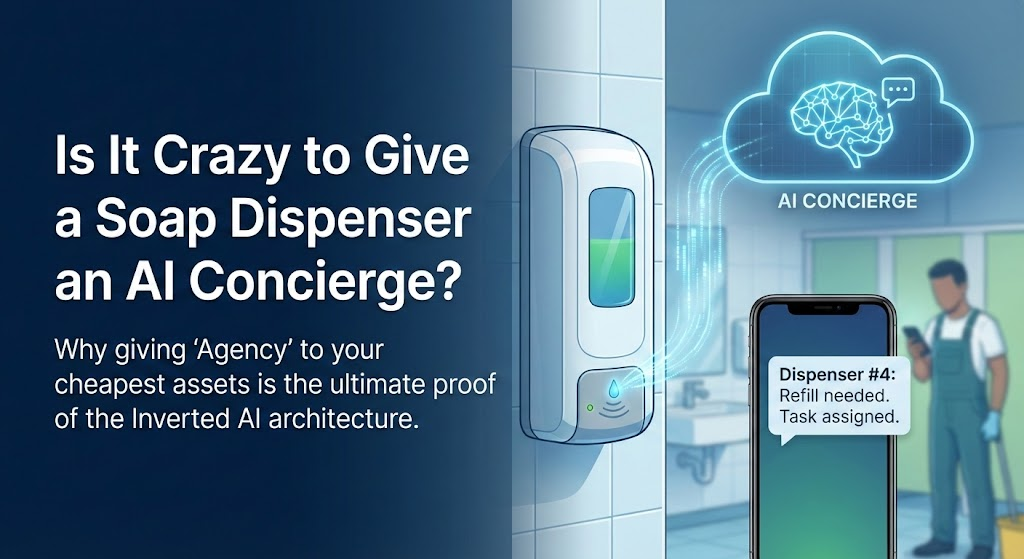
Now, the device doesn't just update a database row. It sends a Prompt to the AI Concierge via the universal “chat” endpoint.
While we might imagine the device chatting in plain English, the actual communication is much less informal. To ensure precision, the microcontroller transmits a structured JSON payload representing the "ground truth" of its physical state:
JSON
123456{
  "device_id": "Restroom-94-Dispenser",
  "sensor_value": 0.10,
  "battery_level": "good",
  "timestamp": "2026-02-04T14:30:00Z"
}
The AI Concierge ingests this raw data, combines it with the server-side context (e.g., “It’s only 2 PM and usage is already 90%”), and translates the structured signal into a clear intent:
Device Prompt: “Soap level is at 10%. Usage rate is high today.”
AI Concierge (Server-Side): “Acknowledged. Checking inventory… Stock is available in Closet B. creating Task #902 for Janitor Steve: ‘Refill Restroom 4 immediately.’ Sending SMS alert.”
The dispenser didn't just flash a light. It managed the workflow. It checked inventory, assigned a task, and notified the human—all without a manager getting involved.
The Economics of "Inverted AI"
Why is this feasible now? Because we have flipped the architecture.
In Anthropic's exciting "Computer Use" vision of AI, you need a massive model to visually "look" at screens. That is too expensive for a janitor, let alone a bathroom appliance.
But in the Code On Time Inverted AI:
- The Hardware is Dumb: A $14 sensor.
- The Interface is Cheap: Tiny JSON text packets.
- The Intelligence is Centralized: The "Brain" lives in your Code On Time app, running on a scalable server (and soon, .NET Core containers).
Because the marginal cost of processing a text prompt is fractions of a penny, it creates a new economic reality: Intelligence is now cheap enough to deploy everywhere.
The "Sovereign" Thing
This architecture turns your physical assets into Sovereign Agents.
- They carry an Identity (via OAuth).
- They respect Permissions (they can't order supplies if they aren't allowed).
- They speak Natural Language (or at least, structured prompts that the LLM understands).
When a soap dispenser can truthfully report its state, authenticate securely, and trigger business logic, it stops being a piece of plastic. It becomes a member of the workforce—one that never sleeps, never forgets, and costs almost nothing to employ.
The Verdict
So, is it crazy to give a soap dispenser an AI Concierge?
If you think AI is only for writing poems or code, then yes, it's crazy.
But if you see AI as the ultimate Friction Remover for business operations, it is inevitable.
We are building a future where your business data, your human employees, and your physical infrastructure all inhabit the same secure, conversational mesh. And it starts with a simple prompt: "I need a refill."