RESTful

Learn how to authenticate users with OAuth 2.0 Authorization Code flow with PKCE. Use access tokens with the RESTful hypermedia to work with data.

Labels
AI(15) AJAX(112) App Studio(10) Apple(1) Application Builder(245) Application Factory(207) ASP.NET(95) ASP.NET 3.5(45) ASP.NET Code Generator(72) ASP.NET Membership(28) Azure(18) Barcode(2) Barcodes(3) BLOB(18) Business Rules(3) Business Rules/Logic(140) BYOD(13) Caching(2) Calendar(5) Charts(29) Cloud(14) Cloud On Time(2) Cloud On Time for Windows 7(2) Code Generator(54) Collaboration(11) command line(1) Conflict Detection(1) Content Management System(12) COT Tools for Excel(26) CRUD(1) Custom Actions(1) Data Aquarium Framework(122) Data Sheet(9) Data Sources(22) Database Lookups(50) Deployment(22) Designer(178) Device(1) Digital Workforce(3) DotNetNuke(12) EASE(20) Email(6) Features(101) Firebird(1) Form Builder(14) Globalization and Localization(6) HATEOAS(6) How To(1) Hypermedia(3) Inline Editing(1) Installation(5) JavaScript(20) Kiosk(1) Low Code(3) Mac(1) Many-To-Many(4) Maps(6) Master/Detail(36) Micro Ontology(5) Microservices(4) Mobile(63) Mode Builder(3) Model Builder(3) MySQL(10) Native Apps(5) News(18) OAuth(9) OAuth Scopes(1) OAuth2(13) Offline(20) Offline Apps(4) Offline Sync(5) Oracle(11) PKCE(2) Postgre SQL(1) PostgreSQL(2) PWA(2) QR codes(2) Rapid Application Development(5) Reading Pane(2) Release Notes(186) Reports(48) REST(29) RESTful(30) RESTful Workshop(14) RFID tags(1) SaaS(7) Security(81) SharePoint(12) SPA(5) SQL Anywhere(3) SQL Server(26) SSO(1) Stored Procedure(4) Teamwork(15) Tips and Tricks(87) Tools for Excel(3) Touch UI(93) Transactions(5) Tutorials(183) Universal Windows Platform(3) User Interface(337) Video Tutorial(37) Web 2.0(100) Web App Generator(101) Web Application Generator(607) Web Form Builder(40) Web.Config(9) Workflow(28)
Archive
Blog
RESTful
Monday, February 7, 2022PrintSubscribe
Lesson: Standalone SPA4 with RESTful Hypermedia and OAuth 2.0

The purpose of this tutorial is to create a standalone Single Page Application that uses the Authorization Code Flow with PKCE to authenticate the end users. The user picture and email are extracted from JWT courtesy of OpenID Connect. This app can be hosted on any web server of your choice.

Start the Standalone SPA4 with RESTful Hypermedia and OAuth 2.0 segment.
Standalone SPA4 with RESTful Hypermedia and OAuth 2.0
The user interface of anonymous user in the standalone SPA4 with RESTful Hypermedia and OAuth 2.0
Account Access consent form presented to the user during the OAuth 2.0 Authorization Code flow with PKCE in the application created with Code On Time.
Account selector allow users to switch their identity when a client app is requesting account access.
Thursday, January 20, 2022PrintSubscribe
Lesson: Embedded SPA2 with REST Level 2

This lesson explains how to access the RESTful API while ignoring the hypermedia. The hypermedia makes an API self-documenting. Developers can easily discover how to make the traditional REST requests to the application with their favorite API development tool or directly in the browser.

Discover the benefits of hypermedia in the Embedded SPA2 with REST Level 2 segment by learning how to live without it!
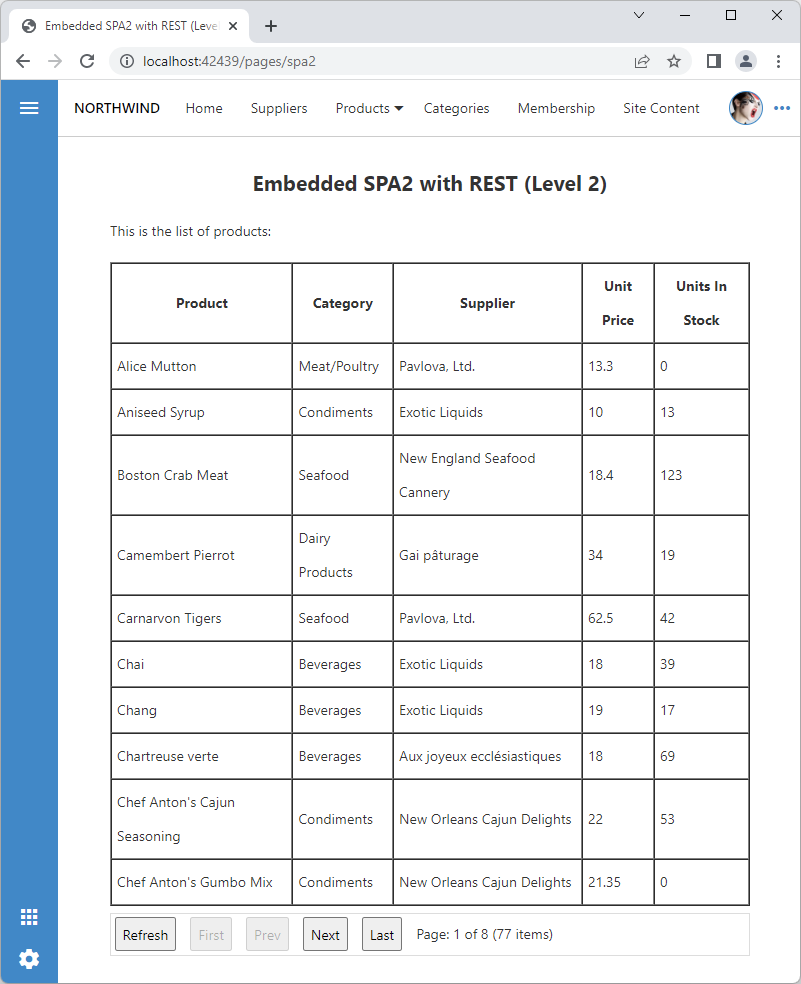
Embedded SPA2 with REST Level 2
Saturday, January 15, 2022PrintSubscribe
Lesson: Embedded SPA1 with RESTful Hypermedia

The lesson explains how to implement the data paging with the RESTful hypermedia. The HTML page is placed directly in the RESTful Application and fetches data from its own host. The page shares the security system of the host application. Users will need to sign in into the host application to view the page in a browser..

Start building your first Embedded SPA with RESTful Hypermedia.
Embedded SPA1 with RESTful Hypermedia.