The enterprise AI industry is currently suffering from a severe crisis of trust. From lawyers submitting fabricated case citations to developers watching their AI-generated code dissolve into unmaintainable architectural "heresies," the root cause is the same: we are treating Large Language Models (LLMs) as unconstrained creators.
When you give an AI agent a blank page and a massive system prompt begging it not to break the rules (e.g., "Don't drop the database," "Don't invent legal cases"), you are fighting a losing battle. LLMs are probabilistic "people-pleasers." If they hit a dead end, they will confidently synthesize a fake answer to complete the circuit.
To bring AI safely into the enterprise, we have to stop trying to make the AI smarter, and start making its environment stricter.
At Code On Time, we have inverted the problem. We designed the Digital Co-Worker not as a generative coder, but as a mechanical navigator. We call this architecture the Hypermedia State Navigator (HSN) Pattern.
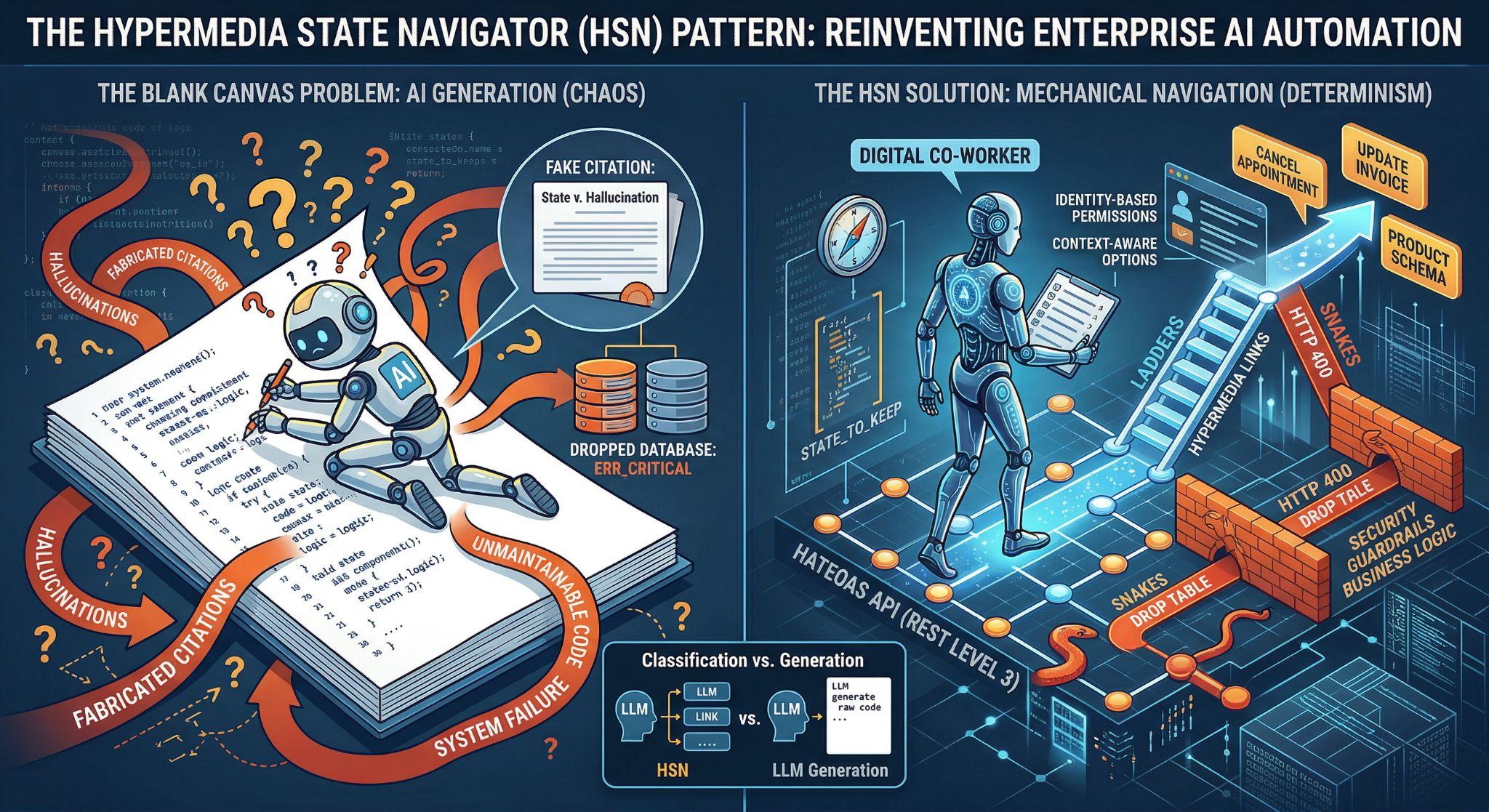
What is the HSN Pattern?
In formal engineering terms, the HSN pattern is defined as follows:
Multiple navigators (agents) traverse a hypermedia-enhanced data graph projected to the prompter's identity, carrying with them the goal and relevant facts (a `state_to_keep` array).
Instead of generating raw code, SQL, or JSON, the AI agent interacts exclusively with a REST Level 3 HATEOAS API. The API dynamically generates `_links` (state transitions) based on the strict business logic, security permissions, and identity of the person requesting the work.
If you prefer a less formal definition: The AI is playing a game of Snakes and Ladders.
- The Pre-Printed Board: The AI doesn't invent the game; the live API provides the board.
- The Ladders (Hypermedia Links): When the AI lands on a valid state, it evaluates the `_links` array to climb closer to the user's goal.
- The Snakes (Architectural Guardrails): If an action is unauthorized or logically invalid, the API physically removes that link from the payload. If the AI somehow hallucinates a move, it hits a "snake" (an HTTP 400 error), slides back to its last known safe state, and recalculates.
The Physics of Server-Driven Cognition
By forcing the AI to "inch" toward a goal using progressive disclosure, the HSN pattern solves the three most catastrophic flaws of modern agentic AI:
1. Context Window Bloat
Dumping a massive project's schema or a global metadata map into an LLM's prompt guarantees that its attention will degrade into noise. The HSN pattern forces the AI to carry a lightweight backpack—the `state_to_keep` array. It holds only the user's core objective and the immediate breadcrumb trail. As the agent drills down into a specific record or UI node, the context window remains pristine.
2. Classification Over Generation
When an AI writes code, it performs generation in an infinite state space. Hallucinations are inevitable. The HSN pattern forces the AI into classification. The LLM evaluates a finite menu of valid `next_link_url` options provided by the server and simply picks the most logical one.
Because LLMs still possess a probabilistic drive to "think out loud" and generate text, the HSN pattern quarantines this creativity into a `next_link_reason` field. The AI can write its "story" of why it made a choice in the reason field, but the state machine only executes the highly deterministic URL.
3. The Hallucination Firewall
You don't need to write a system prompt telling the agent not to delete a paid invoice. When the agent queries a paid invoice, the engine of the host app created with Code On Time evaluates the business rules before rendering the response and simply omits the `rel="delete"` link. The AI cannot hallucinate a destructive action because the topological constraints of the API literally prevent it. The LLM is the water; the HATEOAS state machine is the pipe. It flows incredibly fast, but it can only go where the architecture allows.
Eating Our Own Dog Food: The App Studio
The true test of any enterprise architecture is whether it can build itself.
We are utilizing the HSN pattern not just for runtime business data, but to power the Code On Time App Studio. We have transformed the App Explorer—the deeply nested, highly customizable metadata UI used to build apps—into a virtual HATEOAS resource.
When a developer tells the Builder, "Make the Customer Email field required and add a Regex validator," the Digital Co-Worker doesn't generate raw XML configuration files. It uses a Flash model to navigate the App Explorer's virtual API, clicking the exact same nodes and typing into the exact same property grids that a human would.
If the developer asked the AI to add a Regex validator to an Integer field, the UI state simply wouldn't render that property. The AI hits a constraint, safely grounds out, and reports back. No corrupted metadata. No broken compiles.
Stop Generating. Start Navigating.
The future of enterprise software isn't "Vibe Coding." It is deeply integrated, highly governed automation.
By projecting your business logic as a hypermedia graph, you strip away the fragility of generative AI and harness its incredible speed. The Hypermedia State Navigator proves that you don't need an omniscient AI to automate complex workflows; you just need an AI that knows how to read the board, pick the right link, and play the game.